 |
| The Sherbrooke Forest, Dandenong Ranges Running Trails submitted by Kishore Cunningham Distance: Various choices, Terrain: Undulating trails Highlights: Rainforest, Cafe's for post run Devonshire Tea. |
|
Two of Australia's most famous distance running sons, Ron Clarke and Rob (Deek) de Castella have immortalised this amazing set of running trails in beautiful temperate rainforest just an hour's drive from Melbourne. Back in the '70s and '80s you could join packs of up to a hundred runners, all members of Melbourne's club running fraternity and doing their obligatory "long run" for the week. Each pack would have a favoured route through the forest; each would know when to apply the pressure to test the legs, hearts and lungs of even the hardiest of runners.
Then there's "Areoplane Hill", a short, sharp almost vertical incline that leaves you gasping for air when you get to the top. But if you run down it instead of up, you could just about become airborne! I guess that's where the tag comes from. |
Featured stories from around the world
 These days I seldom get the chance to run "Ferny", but when I do, the memories come flooding back.
by Salil Wilson
 |
The Kalalau Trail |
|
When I first heard about the Kalalau Trail on the Na Pali Coast in Kauai Hawaii I was immediately inspired to visit it. A big fan of trail running, especially in scenic places, it sounded unbelievable. I went to the trail twice, the first time to check it out and do a four miles round trip to Hanakapi'ai Beach just to get a feel for it. It is incredibly beautiful, really breathtaking, up there with the Grand Canyon. The trail is narrow and quite steep in places but fairly well maintained as many people hike to Hanakapi'ai Beach.
Tirandaj, my hiking partner and a veteran of numerous mountain climbs, and I left the hotel at about 5.30 am. It was dark but very mild weather. As we drove about 20 miles to the trail-head I was feeling a mix of excitement, trepidation and anticipation. I had an idea of the splendor of this trail but you never know until you go. We parked the car and began making last minute preparations, ensuring we had everything. Water purifying tablets are an absolute must on this trail. There is plenty of streams along the way to get water and you just can't carry enough to last you the 22 miles. In fact, I carried 2 litres of water and ended up drinking about 7 litres. Once we were sure we had everything we said a quick prayer to the God's of the trail and headed off. It was just becoming light and it was drizzling as we began. |
|
 The second time I went to the Kalalau Trail I was going to go all the way to Kalalau Beach, 11 miles away and return the same day, a total of 22 miles. Once you get to the end of Kalalau Beach your path is blocked by sheer, spectacular, fluted pali. Along the way however you pass some of the most spectacular coastline in the world.
 Leaving the first beach there is a marked drop off in trail quality. From here on the trail is a lot less traveled, it is thinner and far less maintained. However, it is still a trail and you would have to be a complete moron to get lost.
 hello's and kept going with Ke'e Beach firmly in my sights. This is a beautiful beach right at the trail head, it is sheltered from the surf by a reef and is a wonderful place to refresh after a 22 mile run/hike.
About the author:
Rupantar has been the race director of the Sri Chinmoy Marathon Team since 1985, having been asked by Sri Chinmoy to serve in that capacity. As well as working on the big races the US Marathon Team organise each year - the 3100 Mile Race and the Six and 10 Day Race - he also spends a considerable amount of time archiving the Marathon Team's 40 year history on this website.The Sri Chinmoy Marathon Team was formed in the fall of 1977 by members of the Sri Chinmoy Centre, who were students of the Indian meditation master, author, poet and philosopher Sri Chinmoy. The athletic looking teacher had been a champion decathlete, sprinter ,soccer player and volleyball coach at the spiritual community where he lived for 20 years. He had begun requesting his students to place more emphasis on their physical fitness as a means of enhancing and complimenting their practice of meditation. He felt that running was a perfect sport to enhance fitness and well being. Many had begun to practice athletics, particularly long distance running, walking, cycling and swimming. In 1976, 33 members of the Sri Chinmoy Centre organized and ran a continuous , non-stop relay through all 50 states, carrying a flaming torch and calling themselves the Liberty Torch Bicentennial Relay. Sri Chinmoy wished the runners to spread the message of dynamism and kindle the flames of love of country. They covered nearly 9000 miles of running, many runners averaging 100 miles a week in the process. Soon members of other countries conducted relays to show that spiritual people could also be dynamic, responsible members of their communities. We also entered 200 members in the 24 hour bike race in Central Park, garnering numerous awards and developing an appetite for training and racing.
As a service to the running community, the Marathon Team was formed to organize races of various distances. Sri Chinmoy felt that holding races for the public would give the running community joy and an avenue for friendly competition. He encouraged his students to train daily and compete often. On October 2, 1977, our first race of ten miles was held in Greenwich Ct. To make it special Sri Chinmoy had us offer split times every mile, have water and refreshment drinks every mile as well, and to provide enthusiastic support along the whole course. We even had singers line portions of the course and sing uplifting, encouraging songs about running and transcending.
A few weeks later about 60 members of the SCMT participated in the five borough New York City Marathon, starting a tradition that still flourishes today. Sri Chinmoy himself began long distance training, running every day and practicing for any and every local race. His enthusiasm was contagious. We began to search for courses in parks and on the streets of New York. We would even look for the hilliest stretches of road for important resistance training. A giant chart with everyone's weekly mileage was erected on the wall of our meeting hall and gym. Much inspiration was gained from seeing our daily and weekly totals in full view of everyone. Sri Chinmoy began to train for marathons and eventually ran 22 himself, with a best of 3:55:07 at the Heartwatchers Marathon near Toledo, Ohio, on March 25, 1979, at age 47.
We also conducted a monthly lecture series featuring famous local and national runners, who gave talks about their running and encouraged us in our training. Some illustrious athletes included Ted Corbitt, Joe Kleinerman, Nina Cusick, Tom Fleming, Cahit Yeter, Craig Virgin, Bob Beamon, Calvin Smith and Carl Lewis.
In August of 1978 Sri Chinmoy suggested a 47 mile race in celebration of his birthday of 47 years. We hastily organized a 47 mile invitational race amongst the students, with help and advice from Ted Corbitt, the legendary runner and father of ultrarunning in the USA. Fifty-six out of 57 starters finished the race. Our interest in ultramarathons was being created. This particular race provided a springboard for excursions into longer and more demanding events. Talent began to emerge as well from our own group. Virendra Gauthier's time of five hours nine minutes still stands for the men, while Dipali Cunningham heads the women's standard in just over 6 hours, as well as having won the race 14 times for the ladies. Sri Chinmoy himself entered the race a few times and completed it in 1979 within the 13 hour limit with his inspiring determination.
As the number of competitors began to grow so did the number of races. 1979 saw our first marathon and half-marathon offered in Flushing Meadow Park, as well as shorter races and even triathlons. In 1980 we formed our first 24 hour race in Greenwich, Ct. In this race Marcy Schwam , the pioneer American runner, set three women's world track records for 50 miles, 100km, and 100 miles. The following year in the same race Cahit Yeter from New York set a North American 24 hour best of 155+ miles, and Sue Medaglia set a women's 24 hour world record of over 126 miles.
Branches of the Sri Chinmoy Marathon Team were formed in 20 other countries, and have expanded to nearly 100 around the world. Today, the Sri Chinmoy Triathlon in Austrailia is the National Long Course Championship, as well as the 100km road race. Our 24 hour races in Europe are highly respected, particularly in England, France, Germany, and Switzerland. In the 1993 24 hour event in Basel, Switzerland, some 120 runners from 15 countries took part, with the President of the International Association of Ultrarunners (IAU), Malcolm Campbell, calling it " the best 24 hour event ever staged".
The cornerstone of Sri Chinmoy's philosophy is the expression of self-transcendence- going beyond personal limits and reaching new levels of inner and outer perfection. This vision of the complete seeker-runner was also practiced by his students, many of them discovering talents they didn't know they possessed. Some began to train for marathons and ultramarathons, others began long distance swimming training.
As the enthusiasm for running began to grow, Sri Chinmoy felt that standard procedures for his races must be kept. We began to organize races on one-mile or two kilometer loops, using flat courses, so that runners could always expect a chance to do well. Water and refreshment drinks were to always be available, as well as accurate scoring and enthusiastic support. The number of our races began to grow, as weekly two mile events and sprints for children and seniors were offered. We also began to offer much longer races- 70 miles, 100 miles, 24 hours and 5 days.
I984 saw the appearance of the Greek legend Yiannis Kouros at the New York Road Runners Six Day Race, in which he set new standards for 48 hours, and broke the 100 year record for six days by running 635 miles. A few months later Yiannis came back to New York to run our 24 hour race, in which he established new road bests for 100 miles in 11hours 46 minutes, and smashed the 24 hour absolute best by 7 miles with 177 miles. A year later in the same race, but running in the teeth of high winds from Hurricane Gloria, Yiannis broke his own record with 178 miles. In the 1997 Adelaide Sri Chinmoy 24 hour Race, Yiannis Kouros set the new and probably unbreakable world record of 188+ miles( 305 km).
In 1985 we offered our first 1000 mile race in Flushing Meadow Park, the first of its kind in this hemishere in this century. Three runners actually completed the distance in the allowed timeframe. Leading the group was American distance pioneer Don Choi from San Francisco, California.
The Marathon Team also began holding monthly marathons at Flushing Meadow Park, hoping to inspire the runners to increase their capacity at the 26.2 mile distance. The Sri Chinmoy Marathon Team also developed a special and unique relationship with the New York Road Runners Club, the largest running club and organization in the U.S. We would often help them with the scoring of their National championship 100 mile race, as well as their 6 day affair at Randall's Island. We have often participated in the New York Marathon, having had over 350 SCMT runners the last several years, as well as offering support in its organization and providing aid stations along the course and clean-up in Central Park after the race.
Sri Chinmoy took up weightlifting in 1985, slowly working his way up to eventual massive numbers of pounds with his special one arm lift, plus adding unusual lifts and feats of strength. His chronic knee injury prevented long distance running, but did not terminate his boundless energy for excelling at any sport. We had a special 200 mile race in honor of Sri Chinmoy's 200 lb one arm lift, in March of 1986, in which over 30 men and women ran 200 miles in his honor. In January of 1987 he eventually lifted 7,063 lbs in a miraculous one arm lift.
We began to offer track and field meets for athletes over age- 40, men and women, with our annual Sri Chinmoy Masters Games in 1985. Many former regional and national champions and some former Olympians including discus legend Al Oerter have taken part in the Games. Similar events are now held on the West Coast and in Europe. Sri Chinmoy himself practiced sprints and throwing events, as well as weightlifting, a number of one -arm lifting and calf-raise events. In 1991 Sri Chinmoy surpassed his best times in this country for the 100 meters, 200m and 400m set in Puerto Rico in 1984.
In 1987 Sri Chinmoy increased his vision of the running world. He felt that a longer race of 1,300 miles would inspire a challenge for the ultramarathon runners. The Ultra Trio was born- a set of three ultra races of 700, 1,000 and 1,300 miles. World class distance specialists began to attempt the increasingly difficult mileages. This unique race is still contested every fall.
That same year a new running adventure was born- the Sri Chinmoy Oneness -Home Peace Run, a relay run through 55 countries around the world, carrying a flaming torch for peace. The public was encouraged to participate, and local and national officials embraced the event. Over 250,000 people ran with the torch and took part in ceremonies that designated peace as a primary objective for world harmony- one person at a time, one step at a time. The Peace Run is now a biennial event, attracting millions of participants in over 70 countries. The U.S. event runs through all the 50 states, with thousands of runners joining in. Politicians,monarchs, heads of state, celebrities and people from all walks of life take part and hold the torch.
Sri Chinmoy's students began to excel in running and swimming as well. To this day 18 of his students have swum the English Channel, and several others hold or have held distance records for running in various countries, including the U.S., Germany, Switzerland, Canada, Hungary, and Japan. Others have recently taken up mountain climbing as a means of testing their limits.
The Marathon Team held national and world championship events in 1988 and 1989 at Flushing Meadow Park. The 1988 1,000 mile event was the I.A.U. (International Association of Ultrarunners) World Championship. Yiannis Kouros of Greece ran 1,000 miles in 10 days,10 hours, breaking the previous record by 1 1/2 days. Suprabha Beckjord of Washington D.C. won the women's 700 mile race in American Record time. Sandra Barwick of New Zealand set a new world standard for women at 1000 miles in 14 days,20 hours. In 1989 Rae Clark of California set a new U.S. standard for 100 miles and Ann Trason did the same for the ladies in the 24 hour event, besting the entire field for the National Championship, as well as setting a new world women's standard for 100 miles. Later that year Al Howie of Scotland became the first person to complete the 1,300 mile distance in a certified race (17 days 9 hours).
1989 saw the women's world best for 1000 miles claimed by Suprabha Beckjord as she broke Sandra Barwick's time by a mere 27 minutes. In 1991 Ann Trason broke the women's world best for 100 miles in 13 hours 47 minutes in our 100 mile road race. The 1991 Ultra Trio had a field of over 60 runners for all three races- unheard of considering the great distances being attemted. Al Howie came back to break his own record for 1,300 miles by 13 hours and Sandra Barwick became the first woman to run 1,300 miles in a certified race; enroute she smashed the 1,000 miles standard by two days! In 1992 Suprabha Beckjord returned to join the super elite group who have run 1,300 miles in a certified race, which currently totals ten men and six women. In the 1993 1,300 miler, Istvan Sipos of Hungary broke Al Howie"s record by nearly two hours. In 1994 Antana Locs of Canada won the 1300 miler overall, and was the first person to ever complete the 1300 three times. In 1995 Georgs Jermolajevs of Latvia broke the world mark for 1300 miles in 16 days 14 hours.
In 1996, the Marathon Team increased the Seven Day Race to 10 days. Latvian Georgs Jermolajevs won by a slim margin over Australian Dipali Cunningham, 725 miles to 723. A more astounding event took place in the summer of 1996. Six runners toed the line on a flat paved course around a park and a school in the neighborhoods of Jamaica, Queens, New York, only a few blocks from our Headquarters. The worlds' longest race of 2700 miles lasted 47 days, with a remarable five finishers out of six runners. Georgs Jermolajevs of Latvia again prevailed, setting new world marks for 3000km and 4000km as well as 2700 miles, in 40 days 11 hours. Suprabha Beckjord of Washington ,DC finished first for the women in 43 days, one hour.
In 1997 Sri Chinmoy increased the world's longest certified race to 3,100 miles, hoping the runners would again transcend their capacities and inspire the running world . Edward Kelley of Huntington Beach,Ca. won the race in 47 days, 15 hours, even running an additional 7 miles to reach the magical 5000 km barrier. Suprabha Beckjord followed Kelley two days later to finish the 3100 miles as the first woman ever to run that great distance in a certified race. 1998 saw Istvan Sipos of Hungary smash the 3100 record in 46 days, 17 hours. Miss Beckjord repeated as women's champion with another sterling effort in 49 days, 14 hours. In 1999, in the heat of a record hot July, Edward Kelley won the 3100 mile race in 48 days, 12 hours. Suprabha Beckjord also completed the distance for the third time. 2000 had only four starters, but also the youngest finisher in Ashprihanal Aalto, a 29 year old Finn who dominated the race in 47 days, 14 hours. Beckjord again finished, making it four in a row. Rimas Jakelaitis, a native of Lithuania, set a new 1300 mile world best time of 16 days+00:28:10 in another remarkable performance at Wards Island Park. In 2001, Dipali Cunningham from Australia returned to break the women's six-day road record with 510 miles. Ultra pioneer Ted Corbitt, 82, astounded the world by running 303 miles, an octegenarian record thst exceeded the previous record,his own, by 63 miles. Rimas Jakelaitis set a new 10 day event best of 901 miles as the field for the two events swelled to 59 runners. A month later, Ashprihanal Aalto repeated his 3100 mile victory in 48 days 10 hours. Suprabha Beckjord continued to amaze with her fifth finish in a row. In the last race of 2001, Paula Mairer rewrote the women's 1300 record with an astounding performance of 17 days,21 hours, breaking Sandra Barwick's ten year old record.
Madhupran Wolfgang Schwerk rewrote the record books in 2002 with an amazing 3100 mile race of 42 days+13:24:03- some four days under the previous record. In all, Schwerk broke 74 marks for miles, kms and days throughout. In the fall of 2002, Paula Mairer broke two women's world bests-1000 km and 700 miles, both marks set in 1991 by Sandra Barwick , in the 700 mile race of the Ultra Trio.
The horizons of the running world are still expanding according to the remarkable vision of Sri Chinmoy: Run and Become. Run to succeed in the outer world. Become to proceed in the inner world. As we attempt to manifest Sri Chinmoy"s dream for the continuous progress of mankind in all endeavors, we offer our best wishes to all the seeker- runners who share a dream of going where few have ever gone. The challenge and the joy of transcending is the greatest gift and the best opportunity at true satisfaction in human life. Our oneness with their efforts is our true joy.
Sri Chinmoy Marathon Team
by Andrew Peters D.O.

For an athlete to understand the prevention and treatment of foot injuries, he must have some knowledge of the anatomy of the foot. There are more than 26 bones in the foot, all of which articulate (to a greater or lesser extent) with their neighbours. The foot is not a solid lump of bone to be jammed in to a pair of ill-fitting running shoes, and forgotten about! Divided in to 3 parts, the foot is constructed from: the tarsal section, which is also known as the rear-foot, the metatarsal section, which is made up of 5 bones which fan out from the rear foot: the phalages, or bones of the toes. There are 4 arches in the foot: inner and outer arches running the length of the foot, a transverse (side-to-side) arch running on top of the foot, and a transverse arch which runs across the sole of the foot, under the"knuckles" of the toes. These arches help to strengthen the foot, and also give spring to the movements. Should any of the arches become weak or over-strained through incorrect exercise, poor posture, obesity, or ill-fitting footwear, the supporting soft-tissues will stretch, the arch collapses, and the mechanical integrity of the foot is reduced. To cover all possible foot injuries in this article would be over-ambitious, so we will concern ourselves with some of the more common disorders arising in distance runners. Morton's metatarsalgia If the anterior (front) transverse arch collapses, the metatarsals will move closer together. The space between the"knuckles" of the toes is small, but in a healthy foot there is space for the nerves which supply the toes. If that space is reduced, as it is when the arch collapses, the nerve can be trapped. This usually occurs between the 3rd and 4th toes, rarely the 1st and 2nd, or 4th and 5th. The toes affected may go white and numb, and the runner will complain of pain in the forefoot, often describing it as"running with a stone in the shoe". Treatment will include assessment of footwear (check the width fitting, and make sure that the sole is not too worn or thin, as direct trauma will aggravate this condition), orthotics may be recommended. Exercises should be prescribed to tone the muscles which help to support the arch. Ice post-training will aid the reduction of inflammation in the region, as can the use of non-steroidal anti-inflammatory (NSAID) gels. In stubborn cases, steroid and/or pain-killing injections can help. Do not confuse this condition with the symptoms of a March fracture. March fracture A stress fracture of the metatarsals is known as a March fracture, because it was first described as a condition amongst army recruits, marching with heavy loads. The condition usually arises as a result of unaccustomed loading of the bone, eg a sudden increase in exercise intensity. It is particularly common in adolescents, and middle-aged runners. The 2nd or 3rd metatarsals are the most susceptible to this injury, which results in pain in the forefoot, aggravated by impact. The onset is sudden (unlike the Morton's metatarsalgia, which usually builds up gradually), and the foot will be swollen over the fracture site. It is very often more painful on the dorsum (top) of the foot. Treatment is often conservative in approach: rest from weight-bearing for 4-6 weeks. Some cases require plaster-cast or the equivalent. Advice on the return to training is essential, since it is often poor training regimes which are the origin of this problem. Plantar fasciitis Running the length of the sole (plantar aspect) of the foot is a thin layer (fascia) of muscle. If this layer gets injured in any way, a fasciitis can be started. This condition can be very uncomfortable, and it is worth treating very early on. The fascia helps to support the longitudinal arches of the foot, especially the medial (inner) arch. Anything which causes this arch to flatten or distort will have an impact on the plantar fascia. Yet again ill-fitting or poorly made shoes can have a major impact on the onset of this condition. The long arch must be supported by the shoe, both inside with arch support cushioning, and also by the inner edge of the shoe itself. There is no point in putting designer orthotics in a shoe if the shoe itself is unsupportive. Treatment of this condition is multi-faceted: rest, orthotics, choice of footwear, assessment of gait and running style, physical therapy (massage, articulation etc), exercises, NSAIDS, steroid injections. Do not be surprised if your therapist looks at your standing posture, and checks your back, hamstring and calf-muscle tensions. Many foot problems are the result of injuries or poor adaptations elsewhere in the body, and with plantar fasciitis is commonly the case. RUNNING GAIT The foot forms an interface between the body and the ground. It is designed to accommodate uneven surfaces, while maintaining balance, and also propelling the body forward. Because the feet are the foundations of the body, if there is an abnormality in a foot it may have an impact higher up. Normal foot action when walking or running The heel hits the ground on the lateral (outside) edge. Here it is in a position of supination. The foot rolls forward, and flattens inward to the medial (inside) edge. The flattening arch helps to dissipate shock. The movement from outside edge to inner edge is called pronation. THIS IS NORMAL!. The foot continues to roll forwards, and slightly outwards, to transfer weight on to the first 2 toes for"toe-off". The longitudinal arch will have tightened to provide a strong leverage just before the foot leaves the ground. Over-pronation After heel strike the foot rolls quickly and heavily inwards. The arch remains flattened on toe-off, with the ankle tilted inwards. Causes of over-pronation: Leg length discrepancies, genuvarum and valgum (knock-knees and bow legs) flat feet. Problems resulting from over-pronation: plantar fasciitis, stress fractures, achilles tendonopathies, medial knee problems, hip and/or low back problems. The over-pronating runner needs a firm shoe with good support on the medial aspect of the shoe. The shoe should have a large medial post, a firm mid-foot shank, and a strong, supportive upper. Over-supination The runner lands on the very edge of the foot, then rolls forwards on the outside edge of the foot, before a slight pronation just before toe-off. The long arch does not flatten, so shock is not dissipated well by the foot, and is transferred elsewhere up the body. Causes of over-supination: leg length discrepancies, genuvarum, congenital high arch, congenital forefoot supination. Problems resulting from over-supination: Decreased shock absoption leading to early osteo-arthritis. Stress fractures, toe deformities, lateral ankle joint instability and sprains, lateral knee problems. The over-supinating runner needs a flexible,well cushioned she, with a curved last to encourage correct foot motion. The mid-foot section should support the high arch, but not increase the tendency to supination. The subject of foot injuries in endurance athletes is huge, and this article only scratches the surface. Everybody is different, and so each runner should be treated as an individual. This means that footwear will be very personal choice, and your therapist should be treating you as a whole, not just a specific condition. |

Nursing a finicky IT band back to health
By Ian Abbott
February 21, 2005 -- Ian Abbott is an age-group triathlete and massage therapist who answers your triathlon health-related questions. This week, Abbott tackles a reader's painful iliotibial band and tight hamstrings.
Dear Ian,
I have a training question for you. I have problems with tight iliotibial band and tight hamstrings that are causing knee problems. I have received different suggestions for how to stretch the ITB, but they don't seem to work, or I'm not doing it right. What do you suggest?
I'm 42, female, chronic knee problems, ex-swimmer, respectable age-group triathlete -- but struggling. Any help will be appreciated.
Leigh
Leigh,
Thanks for the great question, I hope I can help. There are a fair number of triathletes (myself included) who come from a swim background. While this experience often makes for a speedy first leg of the race it can causes problems in the second and third parts of a triathlon.
You may have noticed that while the ex-swimmers in the pool usually have a pretty good kick, those from cycling and running backgrounds have a tougher time. People who grow up swimming can develop flexible ankles that provide the same flick in the kick as a fish's tale does. Runners and cyclists often tend to have less flexible ankles and feet, making them less efficient swimmers but also less prone to certain types of running injuries.
What this means for you, Leigh, is that to compensate for your greater flexibility and range of motion, your hips have to provide stability while you are running. You may have already corrected this partially with orthotics and a good shoe fit. But another factor affecting stability can be pelvic strength. The muscles in the hips and low back are important for pelvic stability, and the gluteus medius is often involved in IT band problems.
The gluteus medius originates in the outer rim of the pelvis and inserts onto the superior aspect of the greater trochanter at the top of your femur. It functions to abduct the leg, or move it away from the midline, and it plays an important role in providing lateral hip stability. Runners tend to be very strong going straight forward but lack the lateral strength of tennis and basketball players. A weakness in the gluteus medius means that another muscle, called the Tensor Facsia Latae (TFL), is over-recruited. The TFL, found on the front of your hip and slightly to the outside, acts to provide knee stability by working with gluteus maximus to contract the Iliotibial band. So, if your gluteus medius is weak, your TFL has to work too hard, increasing the tension on your IT band, which can result in problems at the knee. This can cause unwanted tension through the hips, low back and hamstrings and can also result in increased tension through the hip flexors, which can tilt the pelvis forward, making the hamstrings feel tight even though they actually being overstretched.
Here are a couple of stretches and an exercise that hopefully will get you on the right track.
Stretch #1: Hips and IT band
Place your body at such a distance from a wall that you feel a mild pull at your hip, down your IT band or both. As the stretching sensation eases, move your body closer to the wall. But remember, stretching always needs to be done pain free. Stretch both sides for at least 30 seconds to a minute. I like this stretch because you can get into it and relax or read a book or watch TV and spend some time with it.
Photo by: courtesy Ian Abbott
Stretch #1: Hips and IT band
Stretch #2: Hamstrings
This hamstring stretch is good because you are not weight bearing, so you don't end up overloading the hamstrings as when you bend over and touch your toes. Using a belt or strap, pull your leg toward you with the knee slightly bent. The other leg should be flat on the floor. Hold the stretch for 30 seconds to a minute.
For a twist, try this: When you have pulled on the strap to the point where you feel a mild pull in the hamstring, push your leg against the strap. Don't let your leg move, simply push into the resistance. Count for six seconds and relax. At this point you can pull your leg further into the stretch. You can do the contract relax two to three times while stretching.
Photo by: courtesy Ian Abbott
Stretch #2: Hamstrings
Clamshell exercise
This exercise will help strengthen the gluteus medius.
1) Position yourself in a three-quarter-prone pose with your arm under your head for support. Keeping the lower leg straight, bend the knee of the upper leg and hook your foot behind the knee of the lower leg.
2) Start with the knee of the upper leg on the ground.
3) Slowly lift the knee of the upper leg just past horizontal, then lower back to the ground. Start with about 10-15 reps on each side and increase by 5 reps per week as it becomes easier.
Photo by: courtesy Ian Abbott
Clamshell exercise
Ian Abbott is a Victoria, Canada-based triathlete and massage therapist who works out of out of the Cedar Hill Sports Therapy Clinic. In his seven years of practice he has worked with members of Canada's national triathlon, swimming, rowing cycling, and cross-country ski teams. Ian trains with Olympian Samantha McGlone plus Kelly "Mountain Man" Guest under the wise and watchful eye of Cliff English at Competitive Edge Training.
If you have a multisport-related wellness-related question for Ian, please e-mail Triathlete Magazine Interactive.
Over the years Sri Chinmoy, an avid athlete and self-transcendence advocate, has written and spoken on numerous topis related to running and training. Enjoy the topics listed below.
2 weeks prior to a race:
· Avoid caffeine, diet sodas and alcohol.
· Maintain an adequate balance of electrolytes by taking in sports drinks as well as plain water for hydration.
· Increase fluid intake. Be sure that your urine is a light yellow.
· Slightly increase carbohydrates. Maintain a 60% carbohydrate / 40% protein ratio. Don't worry about a depletion / loading cycle.
· Don't try anything new in terms of diet or fluid intake.
· Be well rested. Getting a good night's sleep two nights before the race is more important than the night before the race.
Morning Of The Race
· Have your last meal 3 hours prior to the start: 75 - 100 grams of carbohydrates (complex carbohydrates / maltodextrins).
· Drink 10 - 12 ounces of fluid each hour during the 2 - 3 hours before your race, up to 30 minutes prior to the start.
Race / Workout - Fueling & Nutrition
· 15 minutes after you start, begin fueling. This helps your blood sugar and insulin levels adjust to your exercise.
· Maintain fluid intake throughout the race. Your body can absorb no more than 28 oz. / hour. Remember it's critical to supplement with electrolytes to avoid hyponatermia.
· Your body can absorb up to a maximum of 240 - 280 carbohydrate calories / hour into the energy cycle.
· Carbohydrates / complex sugars such as Maltodextrin (18 - 24% solution) are preferred because more calories pass into the blood faster than with simple sugars (6 - 8% solution). Studies have shown that simple sugars result in blood sugar levels below even fasting levels.
· For events longer than 1 hour, supplement with protein along with carbohydrates. Use a 1:4 ratio (p:c) to increase energy levels, and decrease muscle breakdown.
· Continue to supplement electrolytes, especially during hot and or humid weather. You should use a buffered electrolyte supplement containing sodium, potassium and magnesium.
Post-Workout / Race Nutrition
· Immediately begin to replenish fluids.
· Within 30 minutes of finishing, consume 10-20 grams of protein.
· Within 30 minutes of finishing, consume 250-350 calories of carbohydrates (or more). Research has shown there's a 2-hour window during which your body will absorb the protein and carbohydrates lost during exercise. The first 30 minutes of this window are the most critical. Your body will absorb 100% of the carbohydrates and proteins it needs during the first 30 minutes. The level of absorption decreases as the 2-hour window progresses.
Chill Out In An Ice Bath
Take an ice bath - from your hips down - after every hard workout, long run or race. This will reduce intra-muscular fluids and swelling and close down capillaries. It also reduces post-exercise soreness and eliminates delayed onset muscle soreness (DOMS). Fill the bathtub with enough water to cover you up to your naval, then dump in enough ice cubes to cover the bottom of the tub. Sit in the ice cold water for 10 minutes. Initially the shock of sitting in the cold water will take your breath away, but within a few minutes you'll become numb to the cold.
Training for and participating in an ultra-marathon can be an immensely satisfying experience that will give you a tremendous sense of accomplishment. If you trained adequately, maintained good nutritional habits and were physically and mentally prepared, your first ultra will be the precursor to many more!
The keys to successfully preparing for your first ultra-marathon are:
1. Long Runs. Time on your feet. You need to adapt to spending long periods of time on your feet and moving forward. Longer runs (>4 hrs.) can be broken up with walking breaks. In fact, learning to walk and then run again is a key to success in ultra-marathons.
2. Hills! Hills! Hills! Whether your goal race is hilly or not, the more hills you do in training, the stronger you'll be and the better prepared for your ultra.
3. Middle Distance Workout. The weekend run on weeks you don't do a long run (distance weeks) is very important. If the run is around 15 miles, you'll get an excellent workout, and you'll recover quickly from it. You can run this distance as a tempo run.
4. Your Training Speed Will Be Your Racing Speed. Don't let your long runs drag on for hours. Keep your pace up. When doing your long runs, don't let your pace slow down to a shuffle.
You build muscle during the Strength Building phase. During this phase you increase the number of muscle fibers in your leg muscles, as well as the mitochondria and enzymes needed to breakdown lactates during exercise. The Strength Building phase focuses on your ability to produce energy. It also raises your lactate threshold. Workouts during this phase are characterized by hills - hill running and hill drills. Getting stronger is your goal during this time. The Strength Building phase should last about 8 weeks.
If your ultra is on a very hilly course, you may want to increase the number of weeks in this phase to 12. If you're an experienced runner (if you've been running for over 3 years without injury, or have completed 3 marathons), start doing hills (strength building) in the second half of the Base phase. Do one hill workout per week after the first 2 weeks of the Base Building phase. You can do up to two hill workouts per week during the Base Building phase, but don't do a second hill workout if you're running a race that weekend.
In 1979 I had the opportunity to meet with Arthur Lydiard. During our conversation he emphasized the importance of hill training. Lydiard had all his athletes, from marathoners like Barry Magee, 5,000m runner Murray Halberg, to 800m runners like Peter Snell, run hills during both the Base Building and Strength Building phases of their training. Don't increase your weekly mileage during the Strength Building phase, and the length of your long run should remain constant through this phase. Increase the number of hill workouts you do each week, as well as the number of hill repeats you do each session. Don't do more than 3 hill workouts per week and no more than 12 hill repeats per workout.
You can race during the Strength Building phase. If you choose to race, reduce the number of hill workouts by one during race week. You shouldn't require time off, either before or after a race during the Strength Building phase.
Lactate Threshold Workouts
Hill training is an excellent form of a lactate threshold (LT) workout. The purpose of this workout is to build muscles, develop extra capillaries and improve the energy production system in your muscles. It's designed to raise your heart rate up to 95% for at least 2 minutes at a time, then allow your heart rate to drop down between the hard efforts. Start with four 2-minute hard efforts and increase that number each week. Running hills is the best way to raise your heart rate. Don't worry about speed during these hard efforts.
Hill Training
Hill training consists of hill running and hill drills. Hill Training isn't as hard on your body (specifically your legs) since running uphill is less jarring. Research has shown that periods of near maximum heart rate effort for 2-6 minutes produce optimal gains, and hill training produces significant gains in four key measures:
· Improved running economy.
· Increased VO2 max.
· Improved vVO2 max (running speed at VO2max)
· Increased lactate threshold (the ability of muscles to clear lactate from blood)
Hill Running:
Find a hill that's reasonably steep - around 6% grade is perfect. It should take you at least 2 minutes to run up the hill. Focus on your body position going up the hill and going down the hill. On the way up: shorten your stride slightly, increase your knee lift and arm action, and run up on your toes - getting a good push from your hips, knees and especially your ankles and toes. On the way down the hill: lengthen your stride slightly by increasing your follow-through (high foot in the back of your stride; drop your hands so they're near your hips / waist; lean down the hill; focus on landing on the midfoot or forefoot, not on your heel (which will cause a braking action and tremendously increase the impact as you run down the hill.)
Run the hill emphasizing lift off the ground. It's not as important to run fast up the hills as it is to run with good form and a powerful stride. Your heart rate should be at or near maximum when you reach the top of the hill.
After running up the hill, turn around and run down the hill. This is your recovery period, so run relaxed and allow your legs to stretch out. Allow gravity to carry you down the hill, don't accelerate when running down the hill - remember this is your recovery.
Hill Drills:
Hill drills are done at a slow pace. The goal is to get lift off the ground and not to move forward at a rapid pace. Your progress up the hill should be slow. It should take up to 6 minutes to reach the top of the hill. All drills should be performed SLOWLY!
Bounding: Elongate your stride and emphasize arm action. Focus on getting off the ground. Think of jumping over puddles with a long stride.
Skipping: Skip slowly up the hill, emphasizing knee lift and arm action. Focus on getting high off the ground.
Springing: Emphasize knee lift and getting high up off the ground. Don't emphasize forward movement. Think of jumping over logs.
The Strength Building phase should last for at least 6 weeks, but no more than 12 weeks.
Goals of The Strength Building Phase:
Build muscular strength.
· Increase capillary beds.
· Build mitochondria.
· Improve lactate enzyme response.
· Raise lactate threshold.
· Maintain aerobic fitness.
· Maintain and increase VO2max.
· Maintain cardiovascular and muscular endurance.
· Maintain base mileage and distance of long workouts.
Only experienced ultra-marathoners should try a Speed Building phase. Even experienced ultra-marathoners that aren't attempting to "race" an ultra-marathon, including those that are looking to improve their time, would do well to skip the Speed building phase.
If you do use this phase, maintain your long runs, reduce your weekly mileage slightly and add time trials and races as speed work.
Conventional speed work is inappropriate for ultra-marathoners. Instead, on weeks you don't do a long run, run a race - 10K or longer - or do a time trial - again, 10K or longer. Your longest race or time trial, will depend on two factors. First is your ability to run a race at less than maximum effort. If you're capable of racing at 85-90% of maximum effort, races will help you. If you do them at a greater effort, they'll hurt you by limiting your ability to train after the race. The second factor is your ability to recover after a hard effort. If you need 2 or 3 days off after a race, don't race. You'll lose too much training time, and jeopardize your ultra marathon. To speed up your recovery and stay on the road after your hard efforts, pay close attention to NUTRITION AND FUELING.
During Base Building you develop cardiovascular and pulmonary function. This phase focuses on improving your ability to transport oxygen. The workouts during this phase are characterized by increasing the amount of time / distance you're running. Gradually increase your weekly mileage, and increase the distance of your long run. This phase should be the longest of your training. It should last at least 12 weeks and possibly up to 16 weeks.
The Base Building phase is all about building aerobic fitness. Run the same weekly mileage for at least 2 weeks before increasing your mileage. Only advanced runners should do a long run every week. All others should do one long run every 2 or 3 weeks.
You shouldn't race during the Base Building phase. If you choose to race, your effort shouldn't exceed 85% of maximum heart rate. You shouldn't take time off, either before or after a race during the Base Building phase.
Work in 4-week cycles. Week 1 is your "base" week. In week 2 increase your weekly mileage by about 10%. In week 3 increase the distance of your long run, but keep the total weekly mileage the same as week 2. Week 4 is your recovery week - return to "base" week mileage.
This plan gives you 4 long runs, from 20 to 30 miles during a 16- week period, which will prepare you to finish your first ultra marathon. If you're an experienced marathoner, you may increase that number by adding a long run on your "mileage" week - increase the long run that week to the same distance as your "long" week.
Very experienced runners may also add a back-to-back long weekend. Run a long run on Saturday and another long run on Sunday. (Don't attempt this unless you're an experienced runner who has finished many marathons.)
Goals Of The Base Building Phase:
· Build cardiovascular and muscular endurance.
· Increase aerobic fitness.
· Increase weekly mileage.
· Increase length of long run.
· Improve VO2 max.
By Neil L. Cook, BS, MS, Med
Just about anyone can finish a marathon. Finishing an ultra-marathon isn't as certain. Besides the planning, training and commitment, you must be physically and mentally strong enough to complete both the training and the race itself. You'll also need to adapt to the concept of taking in nutrition while training and during the race. Simple energy gels and electrolyte replacement drinks won't cut it when you're running for 5-24 or more hours.
Before you begin training for an ultra, you need to have at least 3 consistent years of running experience. You should also have completed at least 3 marathons. Your marathon finishing times aren't important.
Next, select a race and set a personal goal. Your goal may be just finishing the distance, completing the distance within a certain time, or racing to finish in the top ten. Unless you're a very experienced marathoner, your goal should be just to finish.
Give yourself about a year to prepare. If you've been running marathons regularly, you can prepare in less time - say 6 months. But it's always better to allow more time. You never know when an ankle will sprain, work will be calling, or your family needs a little extra attention. These are normal training disruptions that people usually don't factor into their training. Generally, training for an ultra-marathon is similar to marathon training; however, both your long run and total weekly mileage increase.
There are 5 physiological phases to training: Base Building, Strength Building, Speed Building, Taper/Race And Recovery. From your race date, work backwards to allow 2-3 weeks to taper prior to your race. Speed Building is 6-8 weeks. But, if you're attempting your first ultra, or you're doing an ultra just to finish and not for time or place, this phase can be eliminated - adding half the time to the Base Building and half to the Strength Building phases. The Strength Building phase is 8 weeks. Make the Base Building phase as long as possible.
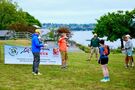
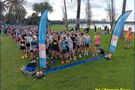
On Sunday 5th November 2006 the Sri Chinmoy Marathon Team held inaugural 50km and a 100km ultra-marathon events in Hagley Park North, Christchurch.
The races were open to both individuals and teams and had a 12 hour cut off.
As with all of the Self-Transcendence races the aim was be to challenge yourself and compete with your own capacities and previous achievements.
What is an Ultra Marathon?
A marathon is 26 miles 385 yards long. An ultra-marathon is any event longer. Typically, 30 miles, 50km, 50 miles, 100km and 100 miles. There are other distances, but those are the most popular. There are also timed events: 12 hours, 24 hours, 48 hours, and multi day-races.
Why do an Ultra Marathon?
For some it's the challenge of going further and longer. For others it's the challenge discovering personal limits, then breaking them. And others have mastered the marathon and are interested in bigger more challenging events.
Marathons are the "ultimate" goal for many runners. But there's a core group of runners that believe the marathon isn't long enough; not enough of a challenge. They feel the need to go longer, sometimes A LOT LONGER! These are different runners, not your average 10 K weekend racer. And although they can be competitive, the camaraderie of ultra-marathoners is legendary. The support for fellow runners during an ultra extends further than any other running event.
Whatever your reason for embarking on this gruelling challenge.you're certain to learn two things about yourself:
1) Your level of commitment to running
2) Your personal limits.both mental and physical
In 2001 NZUA President, Richard Tout, asked Barney McBryde if he would contribute an article to the NZUA News on what he had been up to over the previous few months. Barney had been very active in a number of Ultra events that year, and his response was published in the next issue.
"There are only three winners:
The one who competes with himself.
The one who crosses the finish line first
And the one who finishes the race."
Sri Chinmoy
At 6am on the Sunday of the New Zealand National Championship 24-hour race I did what I had never done before in a race - I quit. The chances of being a winner had just decreased a lot: I certainly wasn't going to cross the line first. . . and I wasn't going to finish the race either. I sat gloomily beside the heater in the lap-counter's tent nursing my right knee.
It had been a great race. . . until 3am. But then it had been a great year.
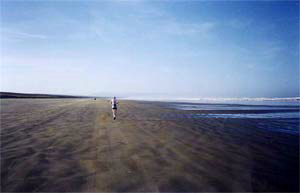
It began on the sands of Ninety Mile Beach; the perfect setting. Any ultra is about leaving everything behind and standing alone before the pride of impossible distance. On the Te Houtaewa Challenge- a 60km race along Ninety Mile Beach- there is only the sky, the sea, the sand and nothing else, and all merge on the horizon over which one must run. A tiny dot resolves itself out of the distance and slowly, ever so slowly draws imperceptibly closer until slowly, slowly it becomes some old Maori woman standing alone with a milkbottle full of water and an old china cup. She pours you some water and hands it to you and takes back the cup with a silent smile when you are satisfied. My mother sometimes ends her letters"aroha nui" (big love)- now I know what she means.
The great moments in ultra running for me are all like that- not the heroic dash across the line (perhaps because mine are never heroic) but rather the girl with the daffodils on the aid station in the Rotorua 100km, Catherine Patton's words of encouragement in the race at Owairaka in 1997, the spirit that one feels at any race, the privilege of racing with legendary runners.
And who is more legendary than Ted Corbitt? 2001 was the year, after six years of running, I finally plucked up courage to do a multi-day race. So I lined up at the start of the Self Transcendence Six Day Race in New York. Amongst the 40 competitors was one who stood out- Ted Corbitt, aged 82.
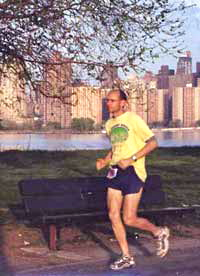
I really only saw Ted's face for the first time at the award ceremony at the end of the race. This was for two reasons. Firstly, because he completed his record-breaking 303 miles hunched forward and leaning to one side, his eyes apparently fixed on the road unfolding before him. Secondly, one only really ever sees the backs of one's fellow competitors. I must confess that although for the majority of the six days of the race I saw his back as I passed him; come Day 6, I saw his back several times as he passed me and disappeared off down the track. To be lapped on a mile loop by a man old enough to be my grandfather- take my age, double it and add ten years- was actually a great honour when that man was Ted Corbitt. At the award ceremony he stood there, his ancient, wise face calm and serene beneath its victor's leafy crown and never said a word as people praised him, applauded him, as the race's creator- in a gesture honouring the man who had so honoured the race by his presence- lifted him overhead with one arm on a special apparatus. What need did he have for words- he had walked the walk, there was no need to talk the talk? If this man is ˜the Father of Ultra Running', as they call him, then this bodes well for the future of ˜his children'. Ultra-running will remain in the pure upper-reaches of the quest for human transcendence.
Musing by my heater at the 24hr race at 6.30am, word came that Jason Holley was back at the track and insisting that I come over to the massage area, that he was going to cure me, and that I was going to carry on with the race. I went, he did, and I did. I missed the distance I had been aiming for, I missed out on reaching 1,000km in races for the year which I had also been hoping for... but I finished the race!- I was a winner!
The fact is that we are all winners in every way.
"You have only one right place
To keep your victory trophy,
And that place is
Your heart's gratitude room"
Sri Chinmoy
There is a lot to be grateful for.
Dhiraja McBryde
Few people look forward to an ultra race. Even fewer positively relish the chance to have ten days of nothing but! Meet one in a million - the indefatigable Niribili File.
Wards Island, New York, 29 April- 9 May 1999, Aucklander Niribili File completes her first 10-day Race.
Yippee! 10 whole days with nothing to do but run- and meditate. The mundane matters of life would be handled by my helper, Eta Field of Christchurch, and she was a tireless worker for the cause.
That was my feeling as I lined up with 7 others at the start of the 10-day race. I confess to a slight nervousness also, conscious of my inexperience. It was my first 10 day, and I was a latecomer to running (started at age 49).
We set off at noon in perfect, mild, spring weather around the 1-mile loop road, winding through the attractive tree-dotted park alongside the river separating Manhattan from Wards Island. The view of the Manhattan skyline, particularly at night, was spectacular- a blaze of light, a view one never tired of. Overhead at one end of the road was a huge motorway bridge which we passed underneath each time around.
On the third day, it seemed that half of New York had descended on our park for picnics, and it was a case of dodging people, noisy motorbikes, and the buggies, roaring up and down until the police got them. Day 5 saw our 14 comrades in the 6-day race joining in, and light rain falling. In the two races combined, 14 different countries were represented.
Overall, the weather was excellent- mild and calm. This, combined with a happy and encouraging atmosphere generated by the Sri Chinmoy Marathon Team organisers, volunteers and supporters, made for most enjoyable running conditions.
The style of the race is"go as you please", which means no timetable. My schedule was simple: sleep from 11pm to 2am, emerge from my tent at 2:30am and (hopefully) keep going, with a snooze after lunch. Two or three counters were on duty in shifts around the clock and food was available at all hours.
The little cluster of custom-made buildings comprising the"camp" are specially erected each year just for the race, taking a week of voluntary work to put up. Dormitories are provided but most runners and helpers prefer to bring their own tents.
But all was not fine and dandy, and I developed shin splints on Day 2. It took massages (ouch), lots of walking and double doses of painkillers over two days for the condition to ease enough to allow running. There was also the unusual remedy of cabbage leaves with ice packs wrapped around the leg.
After three or four days of (yahoo) running again, blow me down- that old shin splint returned with a vengeance. After yet another trip to medical- at least I gave them something to do- I resigned myself to the inevitable and walked the last three days.
In order to achieve a 50 mile per day average, I cut down on rest and on the last night I walked through until closeoff at noon next day. There was a bad patch or two that night, but the reward was a lovely pink sunrise next morning.
Sometimes a mile would take half an hour, but at least I was putting one foot in front of the other. I can't remember a lot of smiles at that stage of things.
Shortly before"time'sup" on Day 10, my goal of 500 miles was realised and I passed by the counters in a fatigued and slightly disoriented state, whereupon someone from the medical tent carted me off for repair work to my ever increasing crop of blisters.
The race gave me the opportunity to test and transcend my inner strength and my physical endurance level. Afterwards the pain was quickly forgotten, but the satisfaction of completing the race remained. I was still in one piece, albeit minus three toenails and 5kg of weight.
I think I have caught the multiday bug.
~~~~~~~~~~~~~~~~~~~~~~~~~~~~~~~~
- ‹ previous
- 19 of 21
- next ›